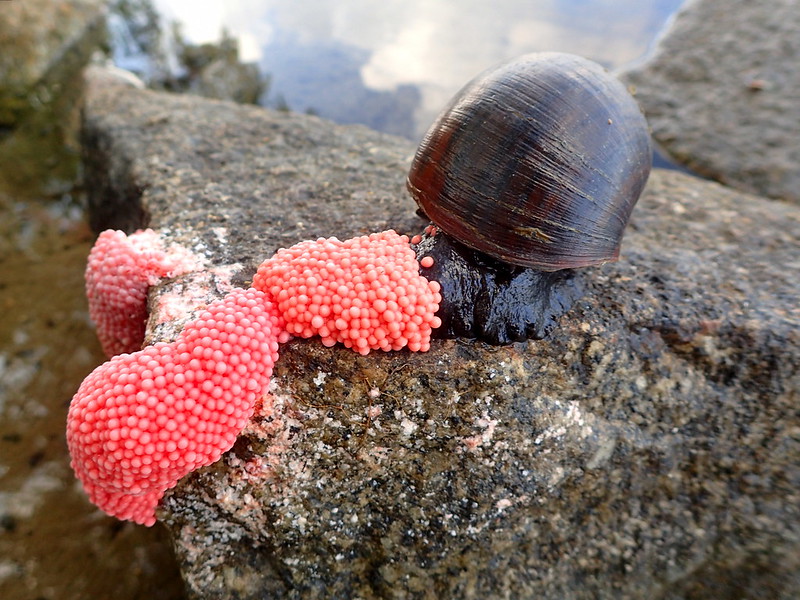
irresponsible aquarium dumping. Reported as early as the 1970s in Texas, they’ve since spread to numerous states. Louisiana documented their presence in 2006.
“The main idea is that they often get a little too large or maybe too abundant, and for whatever reason the aquarium owner decides they don’t want them anymore,” explains Bill Walton, a specialist at the Alabama Cooperative Extension System.
From Culinary Ambition to Global Invasion
The apple snail problem isn’t new.
In 1980s, a species of apple snail was introduced to Taiwan with hopes of launching an escargot industry. The goal was to provide alternative protein sources for farmers, who largely depended on rice for their livelihoods.
However, what seemed like a good idea turned into a disaster. Not only did the snails fail to become a popular food choice — at least, not for the locals — they also brought with them an unpleasant surprise: a parasite known as Angiostrongylus cantonensis (rat lungworm). This parasite can be dangerous to humans if the snails aren’t cooked properly, posing serious health risks.
To make matters worse, instead of helping local farmers, the snails began to threaten Taiwan’s rice crops and disrupt delicate ecosystems. As if that wasn’t enough, the snails spread rapidly across Asia and made their way to Hawaii, where they caused further damage to local agriculture and the environment.
 Continue reading…
